
A modern, minimal, flexible, and easy-to-expand FreeBSD Jail manager built with love by experienced users for both neophytes and experts.
NOTE: This README is a complete guide. We’d like your help to write manual pages :)
Jailer is heavily under development and not yet ready for stable production use. The interface is subject to refinement and change, but you are more than welcome to use it and help us improve it with your invaluable feedback. It does not mean you cannot use it in production, though. Just beware that a lot might change in time.
However, that being said, we do use it in our production to manage servers and in our products.
Jailer is not in FreeBSD ports yet, you need to install it manually
git clone https://github.com/illuria/jailer
cd jailer
make installJailer is so much attached to ZFS and does not support UFS at this time (and most likely it will never do.) In case you are not using ZFS, you can create a ZFS pool by doing something like the following:
truncate -s 20G /usr/local/disk0.img
zpool create zroot /usr/local/disk0.imgCustom Jail Service file for FreeBSD < 14.0-RELEASE
At the moment we use a custom
rc.d/jailfile for FreeBSD < 14.0-RELEASE. Since 14.0-RELEASE, we use the.includefeature ofjail.conf.
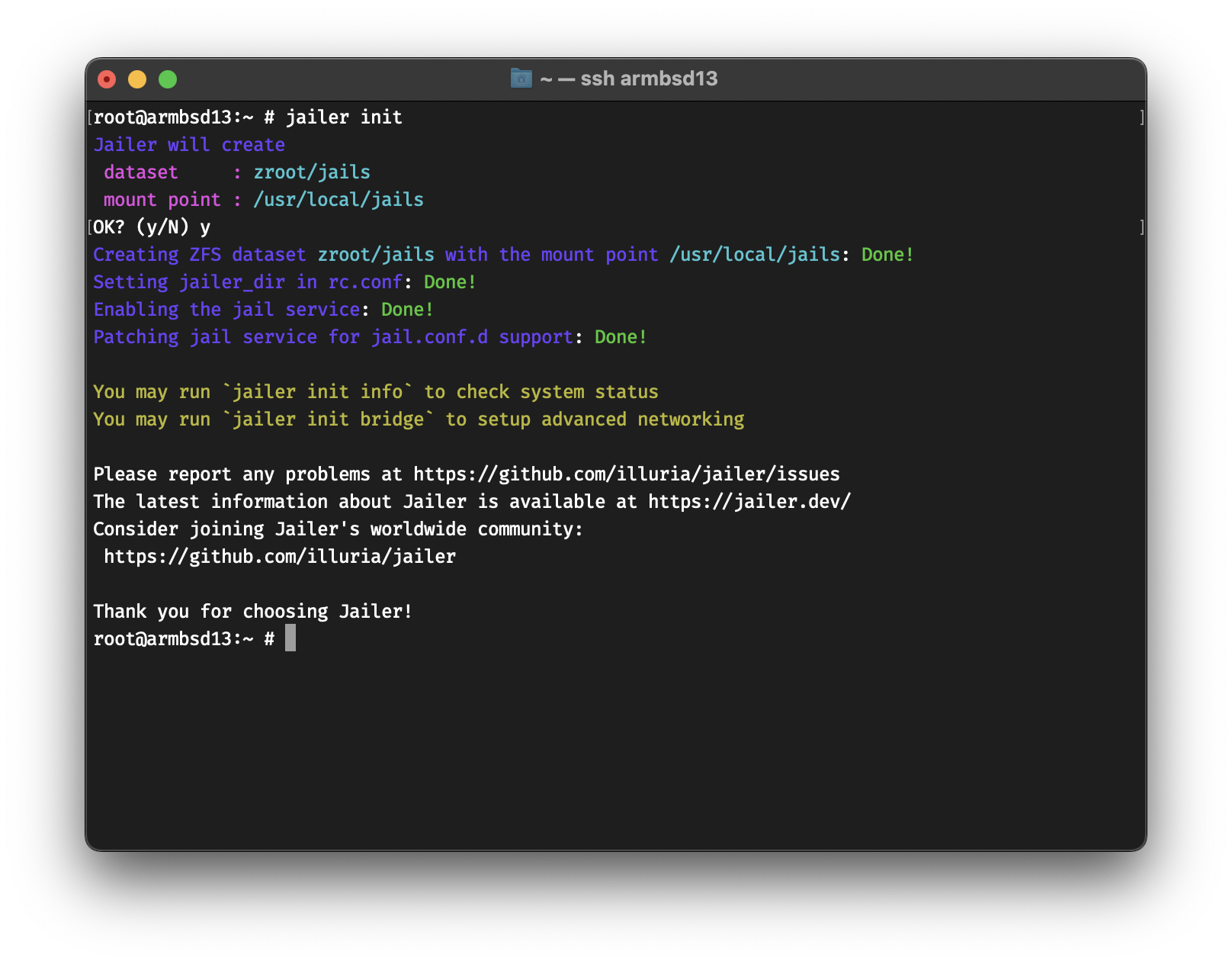
Once the environment meets the basic requirements, Jailer initialization is required. all you need to do is the following:
jailer initHere’s how it looks like →
root@armbsd13:~ # jailer init
Jailer will create
 dataset     : zroot/jails
 mount point : /usr/local/jails
OK? (y/N) y
Creating ZFS dataset zroot/jails with the mount point /usr/local/jails: Done!
Setting jailer_dir in rc.conf: Done!
Enabling the jail service: Done!
Patching jail service for jail.conf.d support: Done!

You may run `jailer init info` to check system status
You may run `jailer init bridge` to setup advanced networking

Please report any problems at https://github.com/illuria/jailer/issues
The latest information about Jailer is available at https://jailer.dev/
Consider joining Jailer's worldwide community:
 https://github.com/illuria/jailer

Thank you for choosing Jailer!
Or, if you like colors, here’s a picture :)
At this point, you can create a Jail
jailer createYou should get the following →
root@armbsd13:~ # jailer create
Fetching 13.1-RELEASE: Done!
Creating 99d6c13c: Done!
By default, Jailer will fetch a base image if it’s not available. You can list all images by doing
root@armbsd13:~ # jailer image list
  13.1-RELEASE
Fetching might take a while, if you know a mirror that’s closer to you, you can set the
FreeBSD_mirrorvariable to that. e.g.setenv FreeBSD_mirror "https://mirror.yandex.ru/freebsd/"withtcshorexport FreeBSD_mirror="https://mirror.yandex.ru/freebsd/"with/bin/sh
You can list and download other images as well
root@armbsd13:~ # jailer image list remote
  12.3-RELEASE
  12.4-RELEASE
  13.0-RELEASE
  13.1-RELEASE
root@armbsd13:~ # jailer image fetch 13.0-RELEASE
Fetching 13.0-RELEASE: Done!
To list all the Jails, you can do jailer list. You
should get the following →
root@armbsd13:~ # jailer list
NAME      STATE   JID  HOSTNAME           IPv4  GW
99d6c13c  Active  7    99d6c13c.armbsd13  -     -
This means that Jail 99d6c13c is using an
inherited network stack, which is NOT
SECURE for production use. In the next part, we will configure
Jails with restricted and isolated network stacks.
You can attach your Jail to an external interface as well. To attach
a Jail to the interface vtnet0 with the IP address
192.168.64.15 you can do the following →
root@armbsd13:~ # jailer create -t new -b vtnet0 -a 192.168.64.15 www0
Creating www0: Done!
root@armbsd13:~ # jailer list
NAME      STATE   JID  HOSTNAME           IPv4           GW
99d6c13c  Active  7    99d6c13c.armbsd13  -              -
www0      Active  9    www0.armbsd13      192.168.64.15  -
Unlike 99d6c13c, which has an inherited network stack,
the Jail www0 has a restricted network stack, we can see
that by logging into the Jail and running ifconfig →
root@armbsd13:~ # jailer console www0
root@www0:~ # ifconfig
vtnet0: flags=8863<UP,BROADCAST,RUNNING,SIMPLEX,MULTICAST> metric 0 mtu 1500
    options=80028<VLAN_MTU,JUMBO_MTU,LINKSTATE>
    ether 52:88:80:9b:bb:00
    inet 192.168.64.15 netmask 0xffffffff broadcast 192.168.64.15
    media: Ethernet autoselect (10Gbase-T <full-duplex>)
    status: active
lo0: flags=8049<UP,LOOPBACK,RUNNING,MULTICAST> metric 0 mtu 16384
    options=680003<RXCSUM,TXCSUM,LINKSTATE,RXCSUM_IPV6,TXCSUM_IPV6>
    groups: lo
The Jail www0 is not aware of any other IP addresses,
but can see the network interfaces. It also has the same networking
that’s available on the host’s vtnet0 interface. If the
host has internet access, so does www0
root@www0:~ # ping -c 1 bsd.am
PING bsd.am (37.252.73.34): 56 data bytes
64 bytes from 37.252.73.34: icmp_seq=0 ttl=57 time=44.368 msJailer can auto-configure the host to have advanced networking. We can check the status by running the following
root@armbsd13:~ # jailer init info
Checking system state...
 jail_enable in rc.conf  ==> YES!
 patched rc.d/jail file  ==> YES!
Checking jailer state...
 jailer_dir in rc.conf   ==> YES!
 jailer_dir is define to ==> zfs:zroot/jails
 Jailer ZFS dataset      ==> zroot/jails
 Jailer ZFS mountpoint   ==> /usr/local/jails
Checking network status...
 bridge0 in rc.conf      ==> NO :(
  If you want Jailer to auto-configure bridge interfaces, run `jailer init bridge`
We can run jailer init bridge to setup internal bridge
networking between Jails and the host
Jailer will configure
 network interface : bridge0
 network address   : 10.0.0.1/24
OK? (y/N) y
Configuring interface bridge0 with IP address 10.0.0.1/24: Done!

You may run `jailer init dhcp` to setup DHCP server for bridge0
At this point, we can run a VNET (Virtualized Network) Jail that uses
an epair to attach to bridge0 (we call that an
eb Jail for epair/bridge)
root@armbsd13:~ # jailer create -t eb -a 10.0.0.10
Creating fd1dafdc: Done!
root@armbsd13:~ # jailer list
NAME      STATE   JID  HOSTNAME           IPv4           GW
99d6c13c  Active  7    99d6c13c.armbsd13  -              -
fd1dafdc  Active  11   fd1dafdc.armbsd13  10.0.0.10/24   10.0.0.1
www0      Active  9    www0.armbsd13      192.168.64.15  -
To assign IPs automatically on VNET interfaces, you can setup a DHCP
server. No worries! Jailer can handle that for you as well! It will
install OpenBSD’s dhcpd, setup dhcpd.conf and
the needed devfs.rules for Jails.
root@armbsd13:~ # jailer init dhcp
Jailer will
 - Install OpenBSD's dhcpd from packages.
 - Setup dhcpd.conf.
 - Create /etc/devfs.rules for VNET Jails.
OK? (y/N) y
Setting up dhcpd, dhcpd.conf and devfs.rules: Done!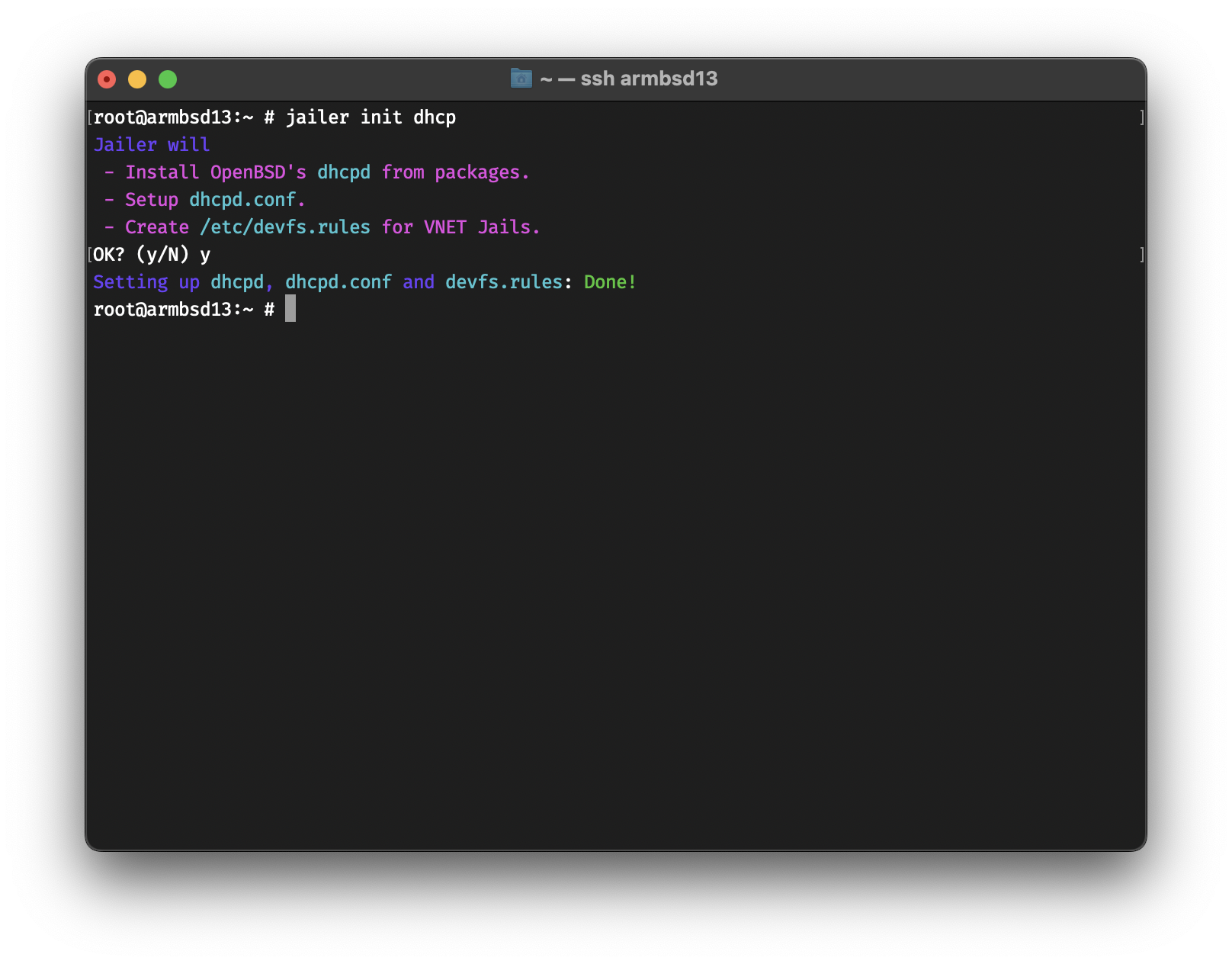
Now you can create a VNET Jail that uses DHCP.
root@armbsd13:~ # jailer create -t eb app0
Creating app0: Done!
root@armbsd13:~ # jailer list
NAME      STATE   JID  HOSTNAME           IPv4           GW
99d6c13c  Active  7    99d6c13c.armbsd13  -              -
app0      Active  12   app0.armbsd13      10.0.0.2/24    10.0.0.1
fd1dafdc  Active  11   fd1dafdc.armbsd13  10.0.0.10/24   10.0.0.1
www0      Active  9    www0.armbsd13      192.168.64.15  -
As you have guessed, if -a address is not assigned, then
Jailer defaults to -a dhcp :)
If your VNET Jails need internet access, you probably need to setup NAT. Here’s the easiest way to do that
# Enable routing
echo 'net.inet.ip.forwarding=1' >> /etc/sysctl.conf
service sysctl restart
# Enable pf
sysrc pf_enable="YES"
# Get default interface
default_interface=$(route get default | grep interface | cut -w -f 3)
# Generate the configuration and start pf
echo "nat on $default_interface from 10.0.0.0/24 to any -> ($default_interface)" >> /etc/pf.conf
service pf start
If you get a message that says
Illegal variable namethen you’re probably usingtcsh. You can jump into/bin/shby runningsh:)
Jailer has the
natandrdrsubcommands to manage NAT and Redirection, but it will be integrated in the next release.
Now, you can login into your VNET Jail and access the internet.
root@armbsd13:~ # jailer console app0
root@app0:~ # host -t A bsd.am
bsd.am has address 37.252.73.34To stop a Jail
root@armbsd13:~ # jailer stop www0
Stopping www0: Done!
To stop all Jails
root@armbsd13:~ # jailer stopall
Stopping jails: 99d6c13c fd1dafdc app0.
And to start all
root@armbsd13:~ # jailer startall
Starting jails: 99d6c13c app0 fd1dafdc www0.
To destroy a Jail
root@armbsd13:~ # jailer destroy www0
Destroying www0: Done!
If you get an error message that says resource is busy, then it probably is. You can force destroy by doing
jailer destroy -f jailname.
ZFS Snapshots are some of its best features. You can snap a Jail to 1) rollback in case something fails 2) create a new Jail base on it.
Create a snapshot of app0 named prod
root@armbsd13:~ # jailer snap app0@prod
Taking the snapshot app0@prod: Done!
Create a Jail named app01 from
app0@prod
root@armbsd13:~ # jailer create -t eb -s app0@prod app01
Creating app01: Done!
In the coming releases, Jailer will have the ability to deploy ZFS Clones as well, which would allow you to save storage space.
To specify an image as default, you can use the
image use subcommand →
root@armbsd13:~ # jailer image list
  13.0-RELEASE
  13.1-RELEASE
root@armbsd13:~ # jailer image use 13.1-RELEASE
root@armbsd13:~ # jailer image list
  13.0-RELEASE
* 13.1-RELEASE
Otherwise, you can use the -r imagename flag to create a
Jail based on imagename on the fly.
As mentioned above, it’s not a good idea to use inherited network
stack on production. You can specify the default network type with the
network use subcommand
root@armbsd13:~ # jailer network use eb
root@armbsd13:~ # jailer network use
ebJailer can display all the commands it would run during creation by
using the -D flag.
root@armbsd13:~ # jailer create -D db0
jail.conf file =>
# vim: set syntax=sh:
exec.clean;
allow.raw_sockets;
mount.devfs;

db0 {
  $id             = "6";
  devfs_ruleset   = 10;
  $bridge         = "bridge0";
  $domain         = "armbsd13";
  vnet;
  vnet.interface = "epair${id}b";

  exec.prestart   = "ifconfig epair${id} create up";
  exec.prestart  += "ifconfig epair${id}a up descr vnet-${name}";
  exec.prestart  += "ifconfig ${bridge} addm epair${id}a up";

  exec.start      = "/sbin/ifconfig lo0 127.0.0.1 up";
  exec.start     += "/bin/sh /etc/rc";

  exec.stop       = "/bin/sh /etc/rc.shutdown jail";
  exec.poststop   = "ifconfig ${bridge} deletem epair${id}a";
  exec.poststop  += "ifconfig epair${id}a destroy";

  host.hostname   = "${name}.${domain}";
  path            = "/usr/local/jails/db0";
  exec.consolelog = "/var/log/jail/${name}.log";
  persist;
}
ZFS commands =>

  (zfs send zroot/jails/image/13.1-RELEASE@base |
   zfs recv zroot/jails/db0)

Resolver commands =>
  cp /etc/resolv.conf /usr/local/jails/db0/etc/resolv.conf
Network setup commands =>
  echo "ifconfig epair6b ether 58:9c:fc:a1:8a:3a" > /usr/local/jails/db0/etc/start_if.epair6b
  sysrc -q -f /usr/local/jails/db0/etc/rc.conf ifconfig_epair6b="SYNCDHCP"
Post-Installation =>
  sysrc -q -f /usr/local/jails/db0/etc/rc.conf sendmail_enable="NONE" syslogd_flags="-ss"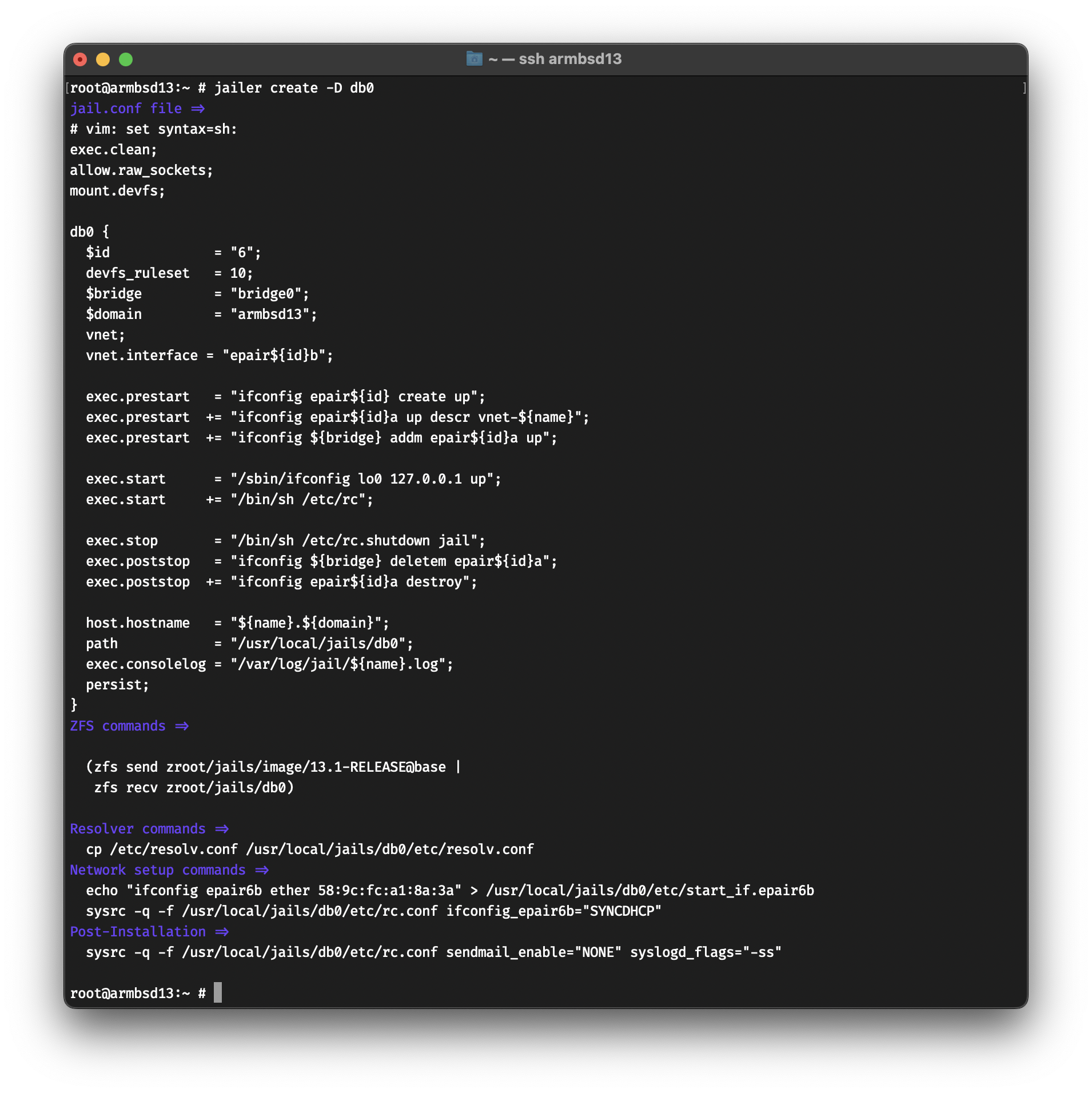
The
-Dflag is named after Dan Langille, who requested this feature during our FreeBSD calls.
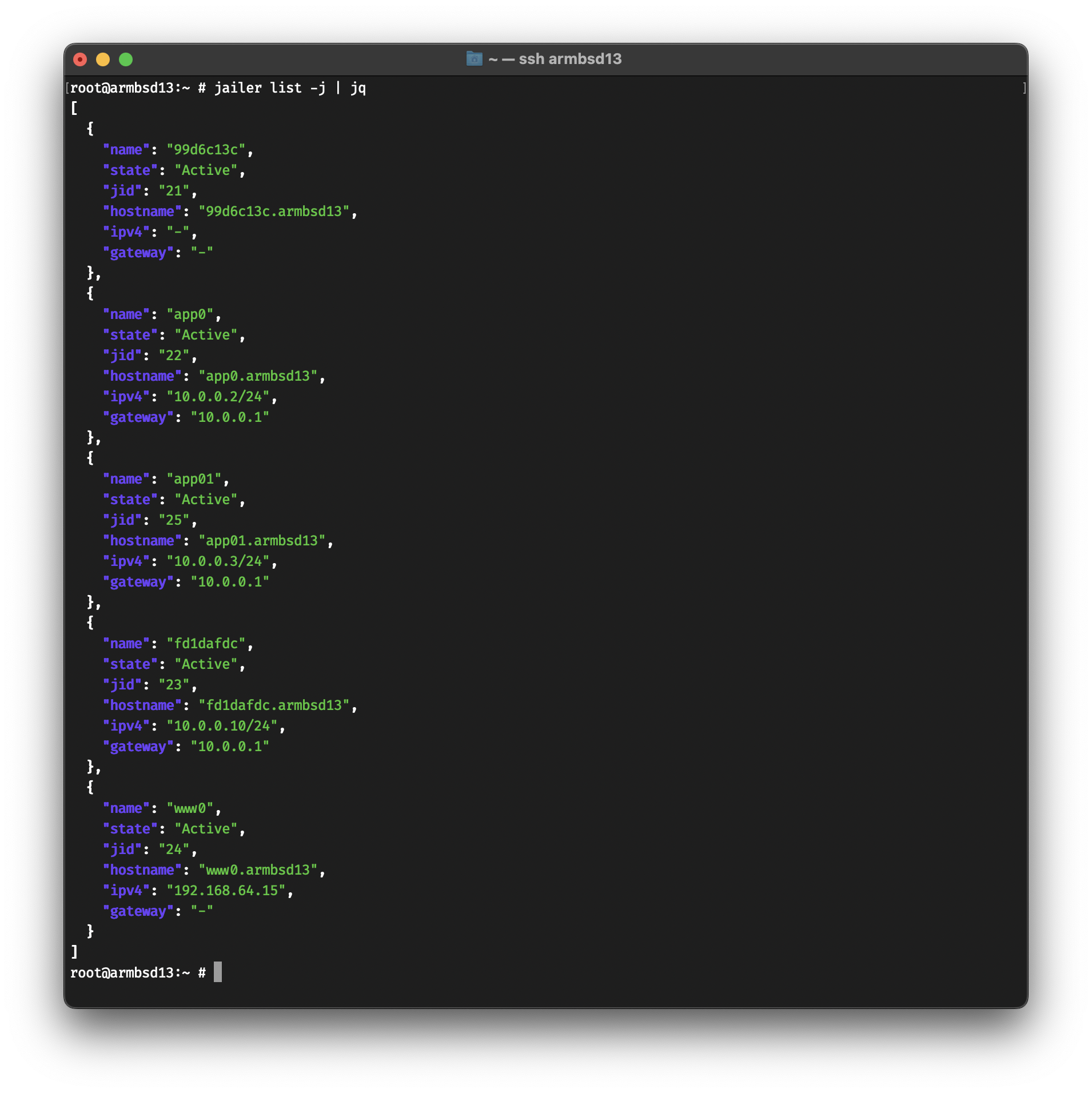
Some subcommands support JSON output.
root@armbsd13:~ # jailer list -j | jqJust remember: keep it hidden from the kids—and definitely don’t let Chi-Chi find it.
Here's a proper write-up:
The Kamehameha is a concentrated energy beam attack that Goku and other characters in the series use to devastating effect. The technique involves cupping one's hands together, focusing energy, and then releasing it in a powerful beam. The Kamehameha has become a symbol of the Dragon Ball Z series, and its popularity extends beyond the anime and manga communities.
Discuss the of fan art and parodies in the West versus Japan Dbz Kamehasutra 2 Full Color English
Dbz Kamehasutra 2 represents a specific era of the internet where fan creators pushed the boundaries of copyright and content. While it remains an unofficial work, its existence highlights the passion of the Dragon Ball community. It’s a testament to how fans want to see their favorite characters in every possible scenario—from saving the universe to the most mundane (or scandalous) private moments. Conclusion
: While official Dragon Ball manga has specific "Full Color" editions released by Viz Media , "Kamehasutra" is a separate fan project that typically features its own full-color digital illustrations. Distinction from Official Media
: The series, specifically "Kamehasutra #2" (sometimes referred to as the "SlappyFrog Edition"), is a fan-created work that combines Dragon Ball themes with mature, adult content. Just remember: keep it hidden from the kids—and
High-quality coloring makes the parody feel like a "lost episode" or an alternate universe, rather than just a sketch. Why It Remained Popular
media produced by Toei Animation and Akira Toriyama, this series is part of the "doujinshi" or fan-fiction community and is not canon to the original story. Overview of Kamehasutra 2 Adult parody, RPG, and fan-comic. Source Material: It takes characters and settings from the Dragon Ball Z
The history and culture surrounding (doujinshi). The Kamehameha has become a symbol of the
This is a Parody/Mature work. Do not look for it if you are underage or offended by NSFW content.
The full-color English edition of Kamehameha 2 would likely be a graphic novel or a manga-style book that showcases the Dragon Ball Z characters and their epic battles. This edition would feature vibrant, colorful illustrations and be written in English for a Western audience.
You are more than welcome to contribute to Jailer, whether it is on code, doc, or just to fix a typo. Please open an issue if you find a bug, or a PR if you have fixed one. All code changes must be reviewed and tested.
In January of 2021, @antranigv and @riks-ar had a bet whether @antranigv is able to
rewrite @illuria’s ZFS, Jail and
ifconfig(8) wrappers from Elixir to Shell. The deal was if
@antranigv failed
to do that in 2 weeks, then @riks-ar gets @antranigv’s desk and chair (which was the
best one in the office at the time). If @antranigv succeeded, then he had the
right to open-source the Shell program at any time in the future.
On October 20th 2022, @illuria open-sourced Jailer by pushing the code to GitHub :)